Showing posts with label wisdom. Show all posts

Saturday, October 12, 2019

Drinking it in

It's raining today: a steady, soaking rain. After a fairly dry summer - we had to water our garden to keep it growing - the trees, grass and shrubs are enjoying the rain.  They are drinking it in gratefully, the leaves perking up where they've been drooping and the grass seeming greener than before.

All of us need that experience of a good, refreshing, cool drink of water ... whether physical or spiritual ... to keep us supple and nourished inside and out. 

It got me to thinking today about what nourishes and feeds me. I have plenty to eat, and clean water to drink, which makes me far richer than over a billion people in the world.  I also have a roof over my head that keeps the extremes of cold and heat out, and more than one outfit to wear - again, more than what billions have - and most days, I take these things for granted!

Photo "Autumn Gold" courtesy of Simon Howden
at www.freedigitalphotos.net
But as Thanksgiving approaches, I find myself feeling gratitude bubbling up from within, for many of the things I normally don't even think about. 

I have so many blessings, not the least of which are those loved ones who live with me: my husband and family (including the four-legged kids too!) who always believe in me, and always look out for my well-being. As Dory said in Finding Nemo, "When I look at you, I'm ... I'm home!" I can't begin to express the degree to which their presence in my life brings me a sense of joy and completion. I only hope that someday they will get an inkling of how important and amazing they are to me.

Sharing the little events of each other's days, the joys and the sorrows, the ups and the downs: these are blessings. Living in the moment, just as creation does, loving every raindrop, every sunbeam, every bit of provision from the Creator, is curiously rejuvenating.  Experiencing all of this with the people I love is quite the trip, and yes, I am drinking it in, like a refreshing thunderstorm after a dry spell. It restores me, makes me whole, and gives me a boost to keep going. I need that, just like I need air ... just like the plants need rain. 

Friday, June 26, 2015

Good fences make good neighbours

Over the last couple of months, ever since someone tromped all over one of my personal boundaries, I've been doing a lot of thinking about boundaries or personal limits, what they are, why they're important, how to recognize them if and when they exist, and how to respect them. I've even thought a little about when it is okay to cross those boundaries, and when it is NEVER okay to do so. 

Until I was in my forties, I didn't even know that personal boundaries existed, because when I was growing up, they didn't. When I started realizing that I had a right to take up space, that others had boundaries that I was not allowed to cross and that the same applied to me, I started realizing how many times throughout my life that people had barged onto my private property, even in the name of "caring," and proceeded to wrestle my rights to the ground. 

For example, I kept a diary when I was a teen. In it, I poured out my hopes, wishes and dreams, ideas I had, no matter how outlandish. I explored the depth of the feelings I was feeling, confided my deepest thoughts, and I found that in doing so, there was an outlet, a way for me to work through a very confusing and intense period in my life. 

One day, my mother found it. 
She read it.
She was horrified by the subject matter and the intensity.

She made me burn it. Not just it, but all of them that had gone before.

I sat in front of the furnace and wept in grief and intense anger and hatred as I burned - page after page - was forced to destroy what to me represented my soul: literally months and years of a journey I could have looked back on in my twenties and thirties ... and laughed about. 

That was a boundary that should never have been crossed. 
My mom thought she was being a good mom, protecting me, raising me "right." But she violated my privacy, judged me, and her punishment was way over the top.

It took me decades to forgive her. And yes, that was something that needed to be forgiven because IT WAS WRONG, and it hurt me terribly, even though she never apologized. 

Photo "White Fence" courtesy of scottchan at
www.freedigitalphotos.net

When I had children of my own, I made mistakes with them too. I remember freaking out when I saw some things that one or the other of the kids was doing ... and then I remembered my old diary. And it made me stop and rethink. And yes, when I'd jumped over a fence onto their territory, I apologized ... eventually.

I remember that while they were still small and there were going to be people coming over to the house for a visit, people with children their age or thereabouts ... I would tell them to go through their things in advance and set aside those "special" toys that they didn't want to share, and we'd put them in a separate room that was off-limits until the guests went home. That way, they didn't have to feel forced to share ALL of their toys. It modeled for them that there are boundaries, that boundaries are a good thing to have, and that they had a right to their own privacy. That was HUGE. 

And it was one thing (among many) which helped me to build their trust over the years so that later, when I discovered something that I thought was horrible, I was able to listen and find out the "why" instead of freaking out and shutting forever conduits of communication that I wanted to stay open. I don't need to share exactly what those things were, because that's their stuff, not mine. But that communication stayed open, and at the end of the day, I'd rather that than secrets and lies.

So here's what I've learned about fences and about being a good neighbour.
  • People have the right to have their own opinions. It is not my job to put them down for their beliefs and lifestyles.
  • "Talking down" to someone is never okay. That includes both tone and body position. If someone is seated, sit. If they are shorter than you are, position yourself to be on the same level as they are, at the same eye level. 
  • Nobody is any better than anyone else, regardless of age, gender, economical status, social standing, race, or belief. We are all in this together.
  • Nobody has the right to tell anyone else what to do. Not even if asked. Giving advice is never a good idea. And downright giving orders (for whatever reason, even "caring,") makes people want to do the exact opposite of what you tell them. And they will never trust anyone who manipulates and controls them.
  • People have the right to feel what they feel. Feelings are not wrong and need never be treated as such, regardless of age or gender. Babies to seniors, male to female and everything in between, feelings are feelings and they are valid and real to whoever feels them. 
  • Kindness and acceptance go a lot further than condemnation and self-righteousness.
Good boundaries really do make good neighbours, good parents, good friends, and good spouses. The virtue of respect is one that - if cultivated in one's own heart and mind - can make this world a much better place. And, like all virtues, it is developed and nourished from the inside out.

Thursday, August 30, 2012

Untangling

I see it a lot in some families, organizations, social circles.  It's the tendency of some people to become so involved, so personally invested in the lives and choices of the ones they care about, that they will actually infringe on the rights of their loved ones to make their own choices, even think their own thoughts - out of an intense need to be needed.  

One person I know describes it as "being up each other's noses."  It's an accurate and descriptive metaphor that speaks of not being able to make a move without the other person (people) knowing.  
I got this photo HERE.  Interesting article, too.

Psychologists call it "enmeshment." It's when one's sense of where the self stops and the other person begins ... gets blurred, tangled - the boundaries eventually cease to exist.  The other person's hurts become the self's hurts ... to the extent that it is impossible for the self to find any happiness if the other is not happy.  

It's extremely dysfunctional.  

It's like a vine wrapping itself around a tree.  You wouldn't think it would make a difference - after all, vines are a lot more flimsy than trees.  But the vine grows up close to the tree, nice and cozy, entwining itself around the trunk, tangling itself in the branches. And as it gets older, it gets thicker.  It squeezes more and more. 

The bark of the tree gets a dent in it.  The vine's growth deforms it ... the tree gives in more and more and more... and eventually the vine chokes the life out of the tree. And when the tree dies ... eventually the vine does too - because trees inevitably fall over when they're dead - and the vine's roots get ripped up; there is no way to separate the two plants. They've become too entangled.

That's scary.  It's even scarier to realize that this is what emotional enmeshment, entangling, does to humans - on both sides. There is no room to grow, to develop, to become all that each can be.  There is no room to breathe.  

Untangling - disengagement if you will - is possible.  It takes quite a while, especially after a lifetime of doing it, but ... the alternative is a life of disappointment, loneliness, bitterness, and resentment. And humans are a tad more resilient than trees AND vines.

The concept of untangling is simple.  It is based on a few simple statements.

I am me.  I have the right to have my own feelings and opinions, my own choices, apart from yours.

You are you. You have the right to have your own feelings and opinions, to make your own choices, apart from mine. 

I have no control over your choices or your consequences.  You have no control over mine. 

I can accept and respect you for your uniqueness.  You can do the same with me. We are different, but that does not need to threaten either of us.

You can grow.  And so can I.

Thursday, July 19, 2012

Getting Messy

We met them as we were leaving our neighborhood to go to our various tasks: my daughter and I to work and my husband to his errands for the day. Big trucks, backhoes, rumbling and beeping, roaring past us, coming in as we were going out.  We wondered what was up. 

My husband was soon to find out.  When he returned home, the whole street was filled with heavy machinery and large, heavy, rubber culverts and cement  access wells.  And every time one of those big machines revved up and moved, the ground literally shook.  By 4 p.m. when hubby left to pick me up from work, he had a splitting headache. 

What were they doing there anyway?  Well, they were digging up the ditches to install heavy-duty culverts, tying them into the town sewer system! They will eventually be covered in soil .... and seeded....we hope.

Now for the "back story."  

We had approached someone - a private contractor - a couple of summers ago and gotten the same exact work done ourselves, because our lawn was eroding and there was a lot of run-off in the spring, and mostly because it was dangerous to mow that steep a grade; there'd been some near-misses with our old push-mower, and someone could have lost a toe or something!!  The man dug up our ditch, installed the culvert, covered it with soil, and raked it smooth so we could seed it.  We paid him um, okay, a fair pile of money to have it done.  He was reasonable ... and it was worth it to us, to have it done. Peace of mind, let's call it.

We were the only ones on our street to have this done at the time, even though after it was done, there were the inevitable questions from the neighbors.  

Now this.  Now everyone's having it done (quite probably without their permission!) and GUESS WHERE the workers put all their tools and heavy equipment?  And the extra mud they're digging out of people's ditches?  

The view from the end of our driveway... the hedge is behind the pipe...
somewhere...
:s

Yup.  RIGHT HERE.  Already they've broken some solar-powered LED lights, and made this huge mess on the very area we had paid to have fixed two years ago.  Including deep tractor treads on our nice, flat culvert surface.  (Sighhhh). And to top it all off, they had used our front lawn as a handy-dandy lunch area, leaving their lunch boxes and their garbage on it. 

That was IT.  I got out of the vehicle, walked down to the lunchboxes, and wordlessly and firmly put them, one by one, in a straight line and following a direct line with the culvert pipe they'd placed not four feet from our fledgling hedge. I took their garbage - a half-full pop can and the top off a yogurt container - and put it with their lunchboxes.  I did each lunchbox separately so that I could be sure that they were watching by the time I was finished.  And then I threw them a scathing, sarcastic grimace as I put the last item in place and walked into the house, shaking my head in disbelief.

Not a word - no explosion, no verbal tirade - nothing of the sort.  But I was displeased (and I let it be known I was displeased) with the lack of respect for our property.  When I looked out a half-hour later, the lunchboxes were gone, and the crew was winding up their work for the day.  

The whole situation got me to thinking (lots of stuff does that...for some reason.)  When we first got our culvert fixed and filled in, and the grass became firm enough to mow, one of the first things that happened when the next summer came around, was that if the neighbors wanted to have a get-together or a yard sale, the extra cars would use our filled-in ditch area as a great place to park.  Hm.  And now this experience with the heavy machinery. How accommodating ... for them.

I guess that when a person gets their life together, and the inner mess starts to give way to some semblance of order, he or she becomes a convenient place for others to to dump their own messes.  The very time that we started learning about emotional and social boundaries was the time when people started infringing more and more upon them - and we had to draw the line over and over again, instead of letting ourselves get walked on.  Kind of like our culvert workers.  

I understand that excavation of all that inner "stuff" can be messy.  My own process was, that's for sure!  And I can expect that when folks start to deal with their own stuff, I might get some of the spillover.  It's okay; it's all part of the process.  But that doesn't mean that I have to stop setting and enforcing my own boundaries.  It just means that I need to be more vigilant about defining just where the line is, given that others need a little bit of leeway.  

Like with our hard-hat friends today.  (By the way, they'll be here in this neighborhood for at least a week..) I could have thrown their lunchboxes at them, yelled at them for screwing up months of hard work in a few short hours. But I didn't.  Instead, I drew the line at the very spot where our own property line merged with the "common property" technically owned by the city: which is where the old ditch that was there two years ago, started to slope downward.  

It was a measured response - and an object lesson for me, firstly to know that it's okay to get messy when fixing a problem beneath the surface, and secondly, for me to know where to set and police my own personal borders while waiting for folks to clean up their messes when they're done.

Saturday, June 16, 2012

Last of his kind

He considers himself the last of his line. His offspring includes only girls.  And he's grateful for that.  

He thinks that it's unfair to perpetuate the kind of heartache that has been so much a part of his family for generations, passed down from father to son.  

In his determination to do everything the opposite of the way things were done to him, he has instead become the first of his kind  -  the first to be kind, the first to actually leave a legacy worth remembering, fond memories to look back on.  He may feel unworthy ... but so often, great men do feel that way.  

He was the first in his bloodline of the last hundred years or so, who actually chose his children over his career.  He dropped things he wanted to do - things that would wait until he got to them - so that he could sit down on the floor and play games with them, listen to their concerns (no matter how small), care about them, or thank them for their help, no matter how great or small their contribution.  His subconscious motto was (and is) "People before things."  To this day, his children know they can go to him with their problems, trust him with their feelings, and he'll listen to them without judging.  He listens because he was never listened to by his own dad and he knows how important it is for kids to feel loved and accepted, to have a safe place to land.  

He personally considers Father's Day a useless holiday.  Yet if anyone deserves to be honoured on Father's Day and every other day of the year, he does.  He raised himself and his younger siblings.  He had no model to go by, nobody to look up to, but he's been a rock, even more so the last three years or so.  And his wife and children look up to him and would go to the mat for him... any day of the week.  He's a wonderful life partner ... and a fantastic dad.  

I just wanted him to know that.  Happy Father's Day, honey.

Monday, April 30, 2012

Heavy on the wisdom

"GOD grant me the 
SERENITY to accept the things I cannot change,
COURAGE to change the things I can, and 
WISDOM to know the difference."

Often when saying this prayer with others, I hear at least one person tag on the phrase, "heavy on the wisdom..." at the end.  

I know what they mean.  

Accepting things I cannot change is hard.  It is.  It isn't some 'lay-down-and-let-them-walk-all-over-you' thing.  It means facing some pretty tough stuff.  It means allowing myself to feel things I would rather not feel about my past, to address them and to respond appropriately to them. (Thanks to a friend who pointed this out!)  It means refusing to try to manipulate people with guilt, and it involves letting people I love make choices I don't agree with and letting them bear the responsibility for their own actions.  It's painful.  It requires the peace and serenity that only God can give - which is why the serenity prayer is a prayer and not a to-do list! 


Found through Google Images at:
http://jayyvm12-english10.blogspot.ca/2010/04/courage-doesnt-always-roar.html
Changing things that I can change is hard, too.  And it takes a LOT of courage.  Courage I Just Don't Have - or I wouldn't be asking for it!  

Changing the things I can change doesn't mean I change them by myself ... because I've tried to change things by myself and have ALWAYS landed flat on my face!  It means relying on the Courage God gives to face my fears, look after myself, and sometimes even do the one thing I have always avoided at all cost: confront someone and ask for what I need from him or her.  (It never gets easier, by the way).  It means not compromising my values just to please someone else.  Only God can give that kind of courage.  And sometimes I just need to admit that on certain days, I need to be willing to allow God to give me that courage... knowing that the change will be difficult but that He will be with me. Always.  

But it's knowing the difference between the two that is the kicker.  "Heavy on the wisdom?"  OH yeah.  Knowing when to walk away and when to stand, turn around and fight? That takes a whole pile of wisdom. Knowing what to accept and what's worth the effort to change? Crucial.  And impossible. Left to my own, I'd choose the wrong thing, every time.  

Wisdom doesn't come from me; it comes from God. (Hence the prayer!)  When I rely on my own inner (and fallible) human resources to help me decide between acceptance or change, I have absolutely NO wisdom to do that.   Many times I would rather pull the covers over my head and hide from the bogey-man - and sometimes, to tell you the truth - I still do.  Lately I've been feeling like that nearly 24/7.  

Life is not easy.  At least it isn't for someone who hears those accusing, cruel voices in her head saying she's not worth it, that things will never change, that she may as well give up.  I know these voices don't belong to God - but when I hear them all the time with no let-up, it's challenging to mute them without sinking into despair, and try to hear His voice above the din.  And when I'm overwhelmed - which I frequently am of late - I rid myself of some of the stressors I don't need, and I take the time I need to listen to what is important.

So yes, I've been praying the Serenity prayer a lot lately - either verbally or not - and adding a heart-felt, "Heavy on the wisdom."

Wednesday, December 14, 2011

When Repetition isn't Vain

In the New Testament we are warned about using "vain (useless) repetitions." Jesus was referring to people who say the same thing to God over and over again, so much that it becomes just words and is done to impress others (or even God!). But there is a kind of repetition that isn't vain. In fact, it's essential.

I was in a co-worker's office today when I mentioned a concern I was having about some changes that are heading our way at work, uncertainty about what it will all mean, and so forth.  She reminded me that the changes of which I spoke were out of my control, that they had not yet been decided, and that there would be plenty of time to discuss them and deal with them when and if they finally did happen.

It reminded me again of words I often repeat in prayer:  "God grant me the Serenity to accept the things I cannot change, Courage to change the things I can, and Wisdom to know the difference."  

Pendant shown at :
http://www.artfire.com/ext/shop/studio/lemonberrystudios
Good words. Important words.  And words I forget all too quickly.  

Mentoring and teaching people lately has brought home to me again the benefits of repetition in learning a new skill or a new way of living.  

It's not a sign of low intelligence or of poor moral character when we forget how to do something a new way or when we're unsure how to act in a situation which used to send us to bed with the covers pulled up over our heads. It's a sign we're learning, and we need repetition of the things and principles that matter in order to cement our new skill - or lifestyle - into our minds and/or hearts, as the case may be.  

And whether it's a skill or a lifestyle, one mistake doesn't mean we've failed.  It just means we need more practice, more repetition, in lots of various situations and circumstances, until finally it's the "new normal."  And that is FAR from useless. 

Thursday, December 8, 2011

Thinking on my feet

The last several weeks I have been taking a class where occasionally I am called upon to give opinions on topics I don't know much about and have no warning about: impromptu topics.  

I knew it before and bemoaned it, and in the last few weeks I have re-discovered that I don't think very well on my feet.  I need time to reflect, to ponder.  More than just a few seconds.  This is one of the reasons I write rather than use any other means of communication.  

Often, I'm just not interested in the topic at hand.  Current events bore and depress me, so I usually refuse to read or listen to the news.  I haven't listened to radio on a regular basis since I was in my 30s.  I got tired of listening to twenty songs I hated to hear the one I hoped they would play.  And I found talk radio filled with nothing but idle prattle which might put me to sleep rather than stimulate me.  

This came home to me yesterday as I had to give a three to four-minute presentation on one of three given topics which were given to me just two minutes beforehand.  The two minutes were for preparation of what I wanted to say and how, and then I was to launch into it.  Moreover, the person who asked me to do this was a virtual stranger to me.  There was absolutely no rapport with this guy.

To top it off, I really wanted to do well, because in mid-January, I will have to do it for real - to keep my French-speaking levels up.

So I stumbled, backed up, repeated myself, made all the classic mistakes, and when I had exhausted all I could think of during the speech, couldn't figure out how to end it.  By the end of it, I was doing what is commonly known as "bullsh**ting." Grasping for words - literally not knowing what the next words out of my mouth were going to be.  

My problem was that I knew that my skills were being judged and I got nervous and insecure.  To top it all off, the presentation wasn't in my mother tongue and I knew that my grammar would be scrutinized as well.  I braced myself for the criticism I would receive.  But all the fellow said was that I had gone over the time, and that I had gone into too much detail while using a personal example.  

I know he was being gracious.  But the fact remained that this realm of not being able to articulate what I think "on the spot" is a known weakness of mine.  I knew it; I've always known it.  And I have always settled for just living with it.  

The Serenity Prayer says, "God, grant me the Serenity to accept the things I cannot change, Courage to change the things I can, and Wisdom to know the difference."  I'm getting better at accepting things I can't change.  I still need a LOT of Wisdom.  And I'm finding that there are more things I thought I couldn't change ... that it appears I can.  

Like thinking on my feet.  Apparently it is a skill that can be learned!!  Who knew?  I went looking on Google this morning briefly, before anyone else was awake, "how to think on your feet."  I was surprised that there was so much written on the subject, and came up with some simple strategies to help me relax and structure my thoughts "on the fly".  As I get closer and closer to my real impromptu presentation, I hope to be able to use some of these techniques.  

One more way to grow.  On my feet.  Huh.

Monday, October 17, 2011

Bound to Happen

I'm sure you've met the kind of people who pay a lot of lip service to living a life of trust and faith, and yet their actions belie their words.  I've been there a few times more than I would like to admit, myself.  We want to believe things will work out fine, but in the final analysis our feeble affirmations do nothing to delay the inevitable that (if we'd really been honest with ourselves) we knew was coming down the pike.  In fact, our denial that anything was wrong might even have put us in danger because we just failed to get out of the way.  After all, things might improve.  (Uh, that's called denial.) Usually it ends up with us being in situations out of which we can't extricate ourselves because we realized it too late, much like when Wile E. Coyote sees a boulder coming toward him and puts up that little teensy umbrella with one hand and a sign that says "Help" with the other hand - without ever thinking of trying to escape it.

We can get sucked into that kind of mind-set too.  It's really easy.  Become obsessed with a single idea to the exclusion of all others and it's bound to happen.  Denial sets in. We ignore the warning signs that we should get away, out of a bad situation, or that we need to seek help for something that is beyond our ability to fix.  

We shove down the doubts that creep in, and try to put a positive spin on things.  Or we succumb to worry that things will end badly, and we become fretful and upset, feeling guilty for "not speaking in faith."  And the inevitable happens.  Stuff hits the fan and we end up hurt, grieving, lost, and bewildered. And disillusioned.

Instead of accepting what circumstances (or people) we can't change, we rail against what is, wonder why it is the way it is, and waste precious energy in trying to find someone to blame for the way it is.  Instead of changing what we can (and from experience I've found that the only thing I can change is my own mind and behavior, and only with help) we hesitate, paralyzed by fear that we'll make it worse.  And when the fallout hits - it usually does - we feel this nameless sense of guilt but we aren't quite sure why.  After all, it has to be our fault somehow, right?

The truth is so much more freeing.  Yes, actions have natural consequences.  Yes, bad things happen sometimes.  Yes, sometimes even after we pray and pray and pray, people get sick, lose their jobs, or are cruel to others, and there seems to be nothing we can do about it.  We rebel against that.  We like to think that we have some control over the outcome.  

The truth is .... that we don't.  It's not out job to control what happens, to dispense retribution for wrongs committed, to fix other people's problems or dysfunction.  The truth is that we can let those things go, that we can release our grip on all those injustices.  We can set boundaries around our own lives and we can trust others to set boundaries around theirs; if they don't, they will learn to do it the hard way.  Just like we are learning  -  if they (and we) are honest, open, and willing.  

It's bound to happen.

Friday, October 14, 2011

Winding up

I've been doing a fair bit of thinking about the process of inner healing which I describe in detail in my book (see the link right under the archives).  

There is a certain mental or spiritual preparation that takes place prior to doing the "hard work" of healing - the day-to-day slogging leg work that (without help) is virtually impossible to maintain.  It's a very slow-motion version of a pitcher "winding up" to pitch a ball - gathering up all the energy that's available and aligning the body and the vision in such a way that when the energy is released, it's extremely focused and will achieve the desired result.  

Care must be taken not to overdo or overextend, and I must say that the process does not come naturally, so coaching and training are essential.  It really helps to have someone beside you at first who has done it before, who can walk you through the necessary steps.  

That "winding up" period is the mental or spiritual determination to do whatever is necessary to be free.  Even if it means admitting (after years of trying and failing) that you can't do it all by yourself.  Even if it means that you have to ask God for help and trust Him to give you the strength to do the next right thing.  Once He is consulted, He is tireless in His commitment to completing the masterpiece He has been given the permission to start.  

It's essential to gather those mental and emotional resources to enter the process of "getting unwrapped."  God's involvement is what gives the healing process its power to transform.  Without that, (and believe me, I've tried and I know others who have tried - and we all bear witness to this) the process will fail.  Every time.  

This is not a one-time thing, either.  It's ongoing.  Drawing strength from God to keep on becoming free ... is essential.  The grave-clothes of the past do tend to get stuck on us sometimes - some things just don't want to loosen their grip on us, and some things we aren't ready to give up.   

Yet, that is. God doesn't give up that easily.

Saturday, October 8, 2011

Forgiveness Frees

I frequently review a few salient points about my own recovery so as to check myself and see if I'm "slipping" - wandering back into old thinking patterns and old beliefs about God, myself, and others.  

One of the quickest ways for me to do a self-check is to review in my mind the faces of those who have said or done things to annoy or even hurt me.  Usually not the old stuff from way back when (although it's probably a good idea once in a while), but the current stuff - like the guy in that other pew in church who made fun of me, or the women who sat in judgment of me because I wasn't a 'girly-girl' like they were.  If I linger upon a face and a feeling of resentment rises up within me, I know that there is some unfinished business and I need to figure out what its source is.  

Source of this photo:
http://katrinasmall.files.wordpress.com/2008/
11/112308_forgiveness.jpg
Forgiveness frees people - it frees the forgiven and the forgiver.  

I don't agree with the idea that forgiveness is not complete unless it is "forgive and forget." Only God forgets when He forgives.  It's His prerogative. 

Rather, I am inclined to think that forgiveness writes across the offense in indelible ink the words "debt written off" in large letters.  The remembrance of that act cannot be erased especially if the injury was deep and/or prolonged; however, it is possible to write off the debt and not expect or desire repayment.  And the miracle of that act of pardon - plus the journey to get there - can help so many people when shared.  Forgetting would just doom us to telling people they have to forgive - without having a clue how to show them how.  It would also leave us wide open for letting others (or even the same person) do the same thing to us over and over.  It hurts for a reason - just like physical pain, psychological or emotional pain is designed to signal us to avoid that kind of pain in the future! 

I also think that well-meaning people are too quick to rush to "you gotta forgive."  Forgiveness means nothing at all when someone apologizes, for example, and we say back to the penitent one, "There's nothing to forgive." Especially when there really WAS something that needed forgiving. Saying there wasn't negates both the wrongness of the act and the remorse of the one who is seeking forgiveness.  Forgiveness means very little when the hurt has gone so deep inside of us and we gloss it over and live in denial by using one of those Christian platitudes like, "God's forgiven that person, so could I do less?"  By refusing to look at it or to process it and deal with all the facets of how it affected us, any forgiveness we give is only on the surface.  Come face-to-face unexpectedly with that person, especially in a place you thought was safe, and that's when you find out what you really feel.  I know; I've been there.  It wasn't pretty.  Forgiveness takes time.  It is costly.  

But it frees.  It frees us to live unfettered, unwrapped lives.  

And it also frees the person who is forgiven even if he or she never knows that we've forgiven him or her.  This is because forgiveness (for lack of a better analogy) loosens something in the heavenly realm, something that was bound, shackled before we forgive.  So when we forgive that person, it allows mercy and goodness to finally be extended - mercy which has been bound up in our hearts and prevented from flowing: it is as though by us not forgiving, we have plugged up the funnel of goodness that God wants to pour into that person's life, because the goodness of God leads people toward repentance.  It's not something I can easily explain; I just know it happens because I've seen it happen in my life.

Often the hardest person to forgive is the one in the mirror.  It's possible to do.  I've been there, too.  Perhaps I'll talk about that another time.  

Monday, September 19, 2011

Nurturing Me

I read a poster recently which went like this :  

Be yourself - truthfully.  
Accept yourself - gracefully.  
Value yourself - joyfully.  
Forgive yourself - completely.  
Treat yourself - generously.  
Balance yourself - harmoniously.  
Bless yourself - abundantly.  
Trust yourself - confidently.  
Love yourself - wholeheartedly.  
Empower yourself - prayerfully.  
Give yourself - enthusiastically.  
Express yourself - radiantly.  

It is curious how frequently we devalue ourselves, thinking that our self-deprecation shows we are not totally self-absorbed, arrogant and insufferable human beings.  Plus it's been my experience that people who undervalue themselves tend to have a hard time valuing other people... I know - I used to BE one.  Sometimes I still AM one.  

The journey of inner healing can be described a journey of three relationships.  First is a relationship with God; second is a relationship with the self; last and just as important is a relationship with others.  If they are not in that order, the balance is off, and life is off-kilter.  

The relationships need to be nurtured.  It's not enough to make these into tick-boxes and say, "Yep, got that, got that, and got that.  Now what?" - it misses the point entirely.  They aren't badges on a cub scout or a girl guide sash.  

Relationship with God is an ongoing thing.  It requires feeding, nurturing.

So is relationship with the self.  

I found myself thinking earlier today about how I've defined self-nurture in the past and how I see it now.  Before, I used to see self-care or self-nurturing in the most negative or superficial of ways: anything from narcissism to spoiling myself with things that aren't good for me and calling THAT looking out for myself.  

Where does that come from?  I think part of it might come from the culture prevalent after the people who grew up during the Second World War got old enough to have children of their own.  They'd had so little that they vowed that their kids would never have it so hard.  And when they had kids, they made sure there was always more than enough to eat, that they never wanted for anything: toys, clothes, food.  The whole mentality behind that "things equals love" generation was that if you had it and you never had it growing up, it was great to give to your children, just lavish it on them - but it really ended up teaching a good many of us that how much stuff you owned (even if you had to go into debt to get it) was how you measured success; special dinners were how you communicated caring, and how you looked was more important than who you were inside.  

Now, I see self-care a little differently, and it is evolving as I continue on that adventure of healing.  It's developed into an acknowledgement that I am worth looking after - but lately I am starting to question exactly what that self-nurturing looks like.  Platitudes I've told myself to make myself feel better about my life and my choices no longer hold up against this newly-emerging sense of what it means to look after me.  

I think that I'm starting to grow up!  (Horrors!!  How did THAT happen?!?)  A lot of my time in recovery from codependency has been spent like someone who all his or her life had lived in a 6-foot x 8-foot bedroom with no room to move around - suddenly being granted a king-sized bedroom : 25 feet by 25 feet.  That is, running around, flailing my arms, screaming "I'm freeeee!" while I run round and round the bed.  But lately I have been doing some more thinking about what it means to look after myself.  It's surprising me what I'm coming up with that at one time, I would have rejected out of hand with a whole lot of labels that made me feel better about staying where I was, about not rocking the boat, about doing things that to me were (and are) "too hard."  

I don't know where all of this is going or even how to get there.  I do know, though, that in another couple of years (in spite of and perhaps because of all that has already changed in my life) I might not even recognize the person I am today.  I do know that I'm not alone in this journey. And I get the feeling that as scary as change is, someday I'll be able to look back at today and wonder why I never started to grow up sooner.

Tuesday, September 13, 2011

Learning to talk

I've lost my lisp.  

A few weeks ago I had a wisdom tooth pulled that had come in crooked - with the chewing surface facing my cheek.  It had been there for over 20 years, and finally got in the way of flossing - so I opted to have it out.  The procedure was painless!  And it's still in the process of healing  - and will for the next few months while the bone re-grows back in.  

Unknown to me, that wisdom tooth was the reason why I had a very slight, almost imperceptible lisp, a way of forming my S words that was more obvious to me than it was to anyone else.  I'd purse my lips a bit, force my tongue to the roof of my mouth with the tip against the back of my teeth and the S sound would come out and sound perfectly normal.  

But I could hear the lisp.  To me it sounded like "ths" and it was a little annoying.  

Until I got the wisdom tooth out.  

As the hole started to heal, I had to get used to extra space in my mouth - it felt like someone could drive a model train through there at first!  And I noticed that I'd make unexpected noises when sneezing (something like Donald Duck!!)  And sometime during that time, I started (accidentally at first) making a real S sound when I said S words.  It kind of surprised me.  That's when I started noticing that the reason I could pronounce that letter was because I could close my teeth.

Finally.

Since the chewing surface of my wisdom tooth pointed toward my cheek, the rounded portion that is supposed to be next to the tongue was actually sitting up against the chewing surface "V" in the back of my bottom molar. It made it impossible for me to close my mouth completely.  That 1/8 of an inch prevented me from forming the S sound with my teeth and so I looked for other ways to compensate - hence the lisp.  

And now it's gone.  I almost don't sound like me (when I hear myself talk from the inside, where a person listens to him or herself.)  

It isn't without its hazards; sometimes the sounds can come out kind of muffled or whistling, and sometimes my cheek feels like it's flapping in the breeze.  And oddly enough, I find myself speaking the old way more often than not.  I go back to the lisp.  It's more comfortable; it's the voice I hear in my head when I think of me.  Yet - I know I don't need to do it anymore.  If I just take my time and think about how I want to say something, I'll do fine.  

But - and this is the weird part - when I'm not thinking about it, it just comes back.  Even though I don't have a reason to do it anymore.  

I've had to teach myself to slow down and talk the new way.  Right now it's about 50-50... which is better than the 90-10 I was doing at first.  

What it takes is practice.  Slow down and practice.  

It's like that in my recovery too.  I've been freed from a lot of things, a lot of survival mechanisms that aren't necessary anymore: guilting, blaming, manipulating, controlling, to name just a few.  The new patterns of behaving: letting go, living in today, letting people bear the consequences of their own actions, not fixing, not obsessing... these things are new to me and they take practice.  It still feels awkward (not as much as it once did) to live my life this new 24-hours-at-a-time way.  I like my life far better when I do.  And yet - sometimes that old habit of freaking out or being obsessed about something someone is doing or has done, will rise up and show itself in my behavior.  Half the time or perhaps a bit more, I can catch myself doing it the wrong way and just reverse my actions in mid-stream (just as I do when I realize I'm lisping again!) But it still does take work - every day.  Several times a day. 

 "The price of freedom is eternal vigilance."  - Thomas Jefferson.

Monday, September 5, 2011

Words, words, words

I took my post title today from Shakespeare's Hamlet (Act II, Scene II).  Hamlet implies that words are of little or no consequence. 

I disagree.  Words are incredibly powerful; the wrong ones can kill a thousand times over whereas an assassin can only murder a person once.  By the same token, the right words can heal, encourage, and build bridges where there once were walls, whereas a material gift will soon be forgotten.  I was reminded of the power of words today when I stumbled across a blog post while surfing the Internet.  It tells a story which is all too common - and which is pretty powerful (click here to read it).  

Some of my most precious memories of growing up are of people who took the time to invest in my life with encouraging words.  A schoolteacher who cared enough to give me individual attention.  A Sunday School teacher who never spoke a critical word to me - not even once. A professor who recognized my talents and encouraged them.  I remember these things because I spent most of my growing-up years constantly feeling like I was a nuisance, a waste of skin, a screw-up.... because of the words I heard from most of the adults and authority figures in my life. 

For many years I held onto these poison words and made them my own - I internalized them and held others at bay with my own belief of them.  Then when I realized that they were poison, I spent a significant amount of time in victim-land ... thinking that there was no way that these things could be reversed. It took a lot of years for me to understand something crucial about this.  While there is no way for anyone in my past to undo the damage he or she has done to me, there is something that I can do.  

I can speak words of healing to myself.  When I first started doing that, it felt so fake.  A large part of me didn't believe what I was telling myself, even though it was true.  Over time, though, the good news that I was worth something, that I was loveable, that my contribution was valuable, etc., started to penetrate the shell of words that hardened my own heart against me.  

Before I could speak words of healing, encouragement, and restoration to others, I first had to speak them to myself, to forgive myself, to nurture myself.  When I did, something else happened that I wasn't quite expecting.  

My abuse magnet turned off.  Victims of abuse tend to attract more abusers to victimize them, and my life was a prime example.  But when I started using kind words on myself, that electric magnet built of all the abuse that I had received - and charged by my own self-talk - lost the current that made it so powerful.  Fewer and fewer bullies felt compelled to use me as a target.  The charge (so to speak) reversed polarity, and I began to naturally repel those who would have taken advantage of me before, those who would have used me as their whipping boy.  This liberated me from relationships that were harming my spirit, and it freed me to be able to offer encouragement, kindness and mercy to those who need to hear it.  

And we all need to hear those words.

Friday, September 2, 2011

Lowest Common Denominator

Let's say his name is Sam.  You know him; everyone has seen him.  He's the homeless guy who occupies the same corner, travels the same route, has the same line to beg for some change on a cold winter's day.  He might live in a cardboard box.  He might live in a dumpster.  He reeks of unwashed clothes, food residue, and stale sweat. 

Sam doesn't talk about where he's been, how he got to live on the streets.  His main concern is the next muffin, the next cup of coffee, staying warm when the weather is cold, getting out of the biting January wind, staying safe from those who would take advantage of his powerlessness.  Most people avert their eyes from him.  Of those who do stop to talk, a number of them only do so to turn down his requests for change.  He goes into a store to get out of the elements.  The store clerks roll their eyes and if he stays too long, they call the police to escort him out.  Not that he's causing a disturbance.  His presence just makes shoppers uncomfortable.  It's bad for business.  

Photo found at
http://static.photo.net/attachments/
bboard/00E/00Ervf-27534584.jpg
A lot of us don't like to look at Sam or at folks like him - those who've been reduced to the lowest common denominator - human and nothing but human, stripped of all the facades.  I wonder if it's because we might see something of ourselves in him, something that we hide away from in our everyday lives.  Something so unutterably soul-wrenching that it takes our breath away.  An honest, uncluttered representation of need.  

In a way, we are all Sam.  We all need someone to show us a little mercy.  We all need ... pure and simple.  Powerless, vulnerable, curious, lonely, needy people.  There is no call for us to declare ourselves (whether consciously or subconsciously) better than he is.  We all need love.  We all need healing.  

I wonder what would happen if the tables were suddenly turned and we who consider ourselves in the majority - or even in the right - were to suddenly find ourselves in the position of being in the minority, being seen as disposable, and/or having to depend upon others the way Sam is forced to do.  I wonder how much of our self-righteousness and superiority would disappear.  

Perhaps it's enough just to consider what it would feel like to put ourselves in his shoes. I hope so.

Monday, August 22, 2011

Serenity - Courage - Wisdom ... part three

"God grant me the Serenity to accept the things I cannot change, Courage to change the things I can, and Wisdom to know the difference." 

I was reading in a daily devotional book this morning; the topic was on watching where you go - something about paying attention to your path.  But it was a verse shortly before that which caught my attention most.  It also happens to be one of my favorite ones in this healing process I call 'recovery' - which is simply another word for 'restored sanity'.  It said, "Above all, guard your heart, for out of it flow the well-springs of life." (Proverbs 4:23)   

(I think I've said before that) I used to think this meant that my heart had to be watched like a hawk, because it couldn't be trusted as far as I could throw a Mack truck.  But it doesn't mean that at all.  It means that my most important relationships are the ones I have with God and with myself (both out of which flow my relationships with others).  It means that only in right relationship with God and with myself (and it is essential to have a nurturing relationship with oneself) can those daily paths be attended to, the ones Solomon told his son to pay attention to.  

"The Creation of Man" detail (God's hand is on the right, man's
on the left) - Michelangelo, Sistine Chapel ceiling 
Source of the image above:
http://thegospelcoalition.org/blogs/rayortlund/2011/03/28/
depending-solely-on-god/
It boils right down to this.  Wisdom to know the difference between the things I can't change and the things I can ... has only come for me with a dedicated focus on my relationship with God, and a commitment to know myself as I truly am, not as others have painted me.  

It's in daily dependence on God.  I believe that this is the only "dependency relationship" that is healthy because it is the only one humans were created for.  The more time I spend with Him, the more grateful I am for His presence. The more I value His opinion and am aware of how much He loves me, the more I want to honour Him in all things. The more I depend on Him, the better I'm able to see what's true, right, and honest, and when I'm just deceiving myself.

He lets me know He is there.  Sometimes in the smallest of ways.  But when I am living in a "God-conscious" state of mind, nearly everything reminds me of His presence, His power to transform, His love.  He even reminds me to take care of myself when I need to do that (and of course, part of that self-care involves keeping my contact with Him close).  When I don't, there's a nameless feeling of uneasiness that creeps in, and sometimes it takes several hours, days, even weeks to pinpoint.  

Sometimes I even have had to be told by caring and loving friends that I am not "myself" lately.  (That's still a new experience for me, because up until a couple of years ago I didn't even know who "myself" was!!)  At such times I look first to that vertical plumb-line and see, yes, it's been shifted off centre and I need to be still and let Him come to the middle - my middle - the centre of who I am.  The less I do (in the sense of frantically trying to please Him with what I do) and the more I allow myself to be (that is, resting in His love, His grace, His power) the more 'opportunities' open up for me to share what He has done in me, and communicate that (or even a part of that) to someone who asks. 

Which reminds me.  I've discovered, in my Christian faith, that if I am not BEing, I might as well not DO anything because it will backfire. Every time. When I am living in daily and intimate relationship with God, it shows in my attitudes toward work, family, friends, leisure, ... everything.  He fills me up with an awareness of Him being with me - and in me.  Out of that automatically flows opportunities to be there, to be a friend, to be a conduit of healing and mercy to the most unexpected (and unexpecting!) of recipients - and for that I can't take one bit of credit.  Nor would I try.

God sets it up, He orchestrates the whole thing, and I'm simply left in awe of how He does it...  I'm just glad to occasionally be there when He does.

Monday, June 6, 2011

Courage

"Courage is tiny pieces of fear all glued together."  - Terry Guillemets

"Courage is being scared to death ... but saddling up anyway."  -  John Wayne

Today a friend told me that he was concerned about something I had said out of frustration on my blog, and informed me that he was saddened and hurt by the way I went about saying it.  His perception was that I was saying something that I never meant.


His approaching me took a lot of courage.  At least for me it would have.  :) 


So rather than get upset and lose sleep - or perhaps even the friendship - over it (something I would have done a few years ago over far less than this) I immediately retracted the post, and told him privately that the perception he had of the way he saw my words was not the intent of them.  I apologized for my frustration and told him what my original intent was. I hope I got my message across without further muddying the waters.

There are things that I can't change.  Usually these have to do with what others decide to do and not do.  I have no control over these, nor do I need to try to fix other people, impose my own solutions on them, or advise them without their express permission. 

There are things I can change.  I can admit that I have made a mistake.  I can take responsibility for my own actions and allow others to bear the responsibility for theirs.


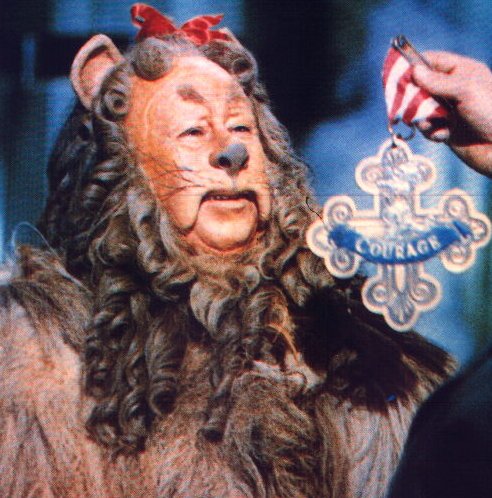
The trick is in having the wisdom to determine the difference between the two in my day-to-day life.  This can be confusing, as the Cowardly Lion found out in the Wizard of Oz.  The Wizard told him, "You, my friend, are a victim of disorganized thinking. You are under the unfortunate impression that just because you run away you have no courage; you're confusing courage with wisdom."  

Actually, by that time the Lion had already discovered the secret of courage: when Dorothy was trapped in the witch's castle, he learned from experience that love overcomes fear.  And in spite of how scared he was, he entered that dangerous situation and played his part to free his beloved friend Dorothy from the green lady's evil clutches.

I guess that is what my friend did.  I applaud him for his courage today, and I realize that in responding the way I did, I was able to face my own fear of losing his friendship and respond honestly and (hopefully) in a loving manner.